The site: Coogee Oval
Drawings:
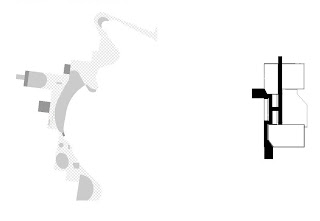
These drawings are mappings and traces arising from site analysis through the consideration of five inter-related words which describe the relationship between architecture and landscape: threshold, infrastructure, insertion, materiality, and reciprocity.

Threshold:
"The operation of threshold explicitly rejects the reduction of passage to an abrupt crossing of a thin edge, or the gratuitous continuity between two entities. Rather, threshold is understood as a
place of becoming, from which
identity as wells as
relationships can emerge. This proposition links a challenge to the autonomy of architecture and landscape with a challenge to autonomy as a necessary precondition of identity in general. It enables a conscious privileging of the spatial and material condition of "
between". It is less about the actual physical permeability of this in-between realm, and more about its role in the formation of identity."1
The drawing for threshold maps the gradual
transition from the built-up to the open, to the natural lanscape, and finally to the expanse of the ocean. From this,the site's identity as a special place within the
pattern becomes apparent. Relating to the other drawings, it can be seen how special places along the thresholds are places which sets up unique relationships between the built and the natural, becoming important entities which shape the identity of Coogee.
Infrastructure:
"the operation of infrastructure posits both architecture and landscape as
originary conditions in an urban environment, where a "natural" or "true" or "real" ground no longer exists. This formulation challenges the idea of a seamless surface - specifically the ubiquitous undulating lawn of the modern landscape - that blurs particularities and differences...In infrastructure, the
graft that
joins landscape to architecture remains visible in an unselfconscious manner, challenging a naturalistic conception of landscape whose "art" is dedicated to concealment."1
The drawing interprets infrastructure as that which
joins. Important places in Coogee, considered important to the community as places where people go to socialise, relax, play, and
interact, were marked. Further analysis revealed that they are joined by the '
web' which is the threshold between the urban environment and the ocean. Again, this shows the importance of the natural landscape along the coastline to the community of Coogee.
Insertion:
"The operation of insertion sets up
activities of relating between a space and its surroundings. Each project in this section is part of an urban continuum, but also represents a break in that continuum - a break that allows the project to exist as a positive entity in its own right, rather than becoming subsumed within a larger whole. This formulation challenges a figure/ground conception of the city, in which "open" space is often merely that which is left over around building-objects.
Configuring the boundaries of a space in order to support
communication between spaces is a critical aspect of this operation, to define a place apart from the city that can also form and contribute to its surroundings."
Insertion is interpreted as being strongly related to
history, to when the first buildings of Coogee were inserted into the landscape. Mapped are places which have important historical significance to the suburb. Many of these places are joined to and relate to the ocean and beach, the cornerstones of Coogee.
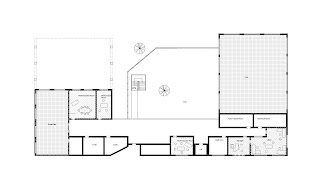
From the first 3 words, the historical and cultural significance of the beach and the coastline is already apparent. The design response, which is to be inserted into the existing fabric, on the threshold between the built-up and the open, should therefore set up relationships between the urban and the natural (beach+coastline), to become an important place which adds to the infrastructure of Coogee.
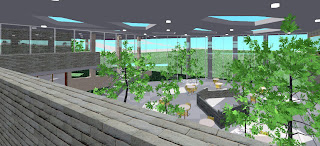
It is also clear that many of the important places in Coogee facilitate outdoor activity and sport, which are also important to the community. The community centre, in contrast, will conceptually be a place that allows indoor sporting and social activity in times of bad/unfavourable weather, as well as a shelter where people can meet and interact with a feeling of being connected to the coastline, but away from the winds, crowds, and various 'hazard' such as stray beach and rugby balls.
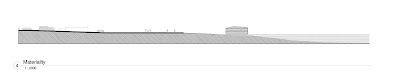
Materiality:
"materiality critiques the conception of landscape and architecture in purely visual terms by focusing on how both practices explicitly share the operation of reconfiguring matter. It challenges the way in which a classical aesthetic framework has relegated matter to the service of form."
The drawing shows how natural and man-made materials are both manipulated and reconfigured to create the desired outcome or function. The 'crust' over which civilisation builds hides the mass of nature beneath, but at the sea, this is not possible. One of the attractions of the beach and ocean are its unrestrained vastness and power, where people can get away from the city and feel in touch with nature.
The prominence of brick buildings may suggest a natural desire to bring an element of nature into the buildings. The challenge in the design will be how to connect the users with nature and break free of the 'crust' over which it is built.

"Reciprocity subverts the hierarchy embedded in the historical dichotomy between architecture and landscape, which has construed landscape as merely the ground on which architecture rests. It recognises the identity of both landscape and architecture as constructed. This formulation challenges the architectural paradigm of the machine in the garden - a vision that opposes architecture's progressive alliance with technology to a nostalgic formulation of landscape as timeless and untouched nature."
Ocean baths.. architecture or landscape? In ocean baths such as Giles Baths, the line between architecture and landscape is blurred. Human interventions ensure a safe bathing area, yet this is constantly in a reciprical relationship with the ocean, the waves flowing in and out. The 'landscape' on which the baths are built - the cliffs and rocks - have been 'constructed' over time by nature, and are constantly in a process of being 'reconfigured'.
An old photo of the bath building and what remains today, shows how the architecture (what is built), and landscape (nature) have both been changed over time through both human and natural action. In this way, an equality between architecture and landscape becomes apparent.